what happens to your hearing at 90 decibels of volume
What is noise-induced hearing loss?
Every day, we feel audio in our environment, such as the sounds from television and radio, household appliances, and traffic. Normally, these sounds are at safe levels that don't damage our hearing. But sounds tin can be harmful when they are too loud, fifty-fifty for a brief time, or when they are both loud and long-lasting. These sounds tin damage sensitive structures in the inner ear and cause noise-induced hearing loss (NIHL).
NIHL tin can be immediate or it tin can accept a long fourth dimension to be noticeable. It can be temporary or permanent, and it tin can impact one ear or both ears. Fifty-fifty if you lot can't tell that you are damaging your hearing, y'all could accept trouble hearing in the future, such equally not existence able to understand other people when they talk, especially on the telephone or in a noisy room. Regardless of how it might affect you, ane matter is certain: noise-induced hearing loss is something you can prevent.
Who is afflicted past NIHL?
Exposure to harmful dissonance can happen at any age. People of all ages, including children, teens, young adults, and older people, tin can develop NIHL. Based on a 2011-2012 CDC report involving hearing tests and interviews with participants, at least x million adults (6 percent) in the U.S. nether age 70—and perhaps as many equally 40 million adults (24 percent)—accept features of their hearing test that suggest hearing loss in 1 or both ears from exposure to loud noise. Researchers have also estimated that equally many as 17 percentage of teens (ages 12 to 19) have features of their hearing test suggestive of NIHL in one or both ears (Pediatrics 2011), based on data from 2005-2006.
What causes NIHL?
NIHL tin be caused by a i-time exposure to an intense "impulse" sound, such as an explosion, or by continuous exposure to loud sounds over an extended period of time, such equally noise generated in a woodworking shop.
Recreational activities that tin can put you at take a chance for NIHL include target shooting and hunting, snowmobile riding, listening to MP3 players at high volume through earbuds or headphones, playing in a ring, and attention loud concerts. Harmful noises at dwelling house may come from sources including lawnmowers, leaf blowers, and woodworking tools.
Audio is measured in units chosen decibels. Sounds at or beneath 70 A-weighted decibels (dBA), even afterwards long exposure, are unlikely to cause hearing loss. However, long or repeated exposure to sounds at or higher up 85 dBA can cause hearing loss. The louder the audio, the shorter the corporeality of time it takes for NIHL to happen.
Here are the boilerplate decibel ratings of some familiar sounds:
- Normal conversation
60-70 dBA - Cinema
74-104 dBA - Motorcyles and dirt bikes
80-110 dBA - Music through headphones at maximum volume, sporting events, and concerts
94-110 dBA - Sirens
110-129 dBA - Fireworks show
140-160 dBA
Your distance from the source of the sound and the length of time you are exposed to the sound are also of import factors in protecting your hearing. A good dominion of thumb is to avoid noises that are too loud, also shut, or last as well long.
How can noise damage our hearing?
To empathise how loud noises can damage our hearing, we have to understand how we hear. Hearing depends on a serial of events that change sound waves in the air into electric signals. Our auditory nervus and then carries these signals to the brain through a complex series of steps.
- Sound waves enter the outer ear and travel through a narrow passageway chosen the ear canal, which leads to the eardrum.
- The eardrum vibrates from the incoming sound waves and sends these vibrations to iii tiny bones in the middle ear. These bones are chosen the malleus, incus, and stapes.
- The basic in the middle ear couple the audio vibrations from the air to fluid vibrations in the cochlea of the inner ear, which is shaped like a snail and filled with fluid. An elastic partition runs from the beginning to the cease of the cochlea, splitting it into an upper and lower part. This division is called the basilar membrane because information technology serves every bit the base, or ground floor, on which key hearing structures sit.
- One time the vibrations cause the fluid inside the cochlea to ripple, a traveling wave forms along the basilar membrane. Hair cells—sensory cells sitting on top of the basilar membrane—ride the wave.
- Equally the pilus cells move upwardly and down, microscopic hair-like projections (known equally stereocilia) that perch on peak of the pilus cells bump confronting an overlying structure and bend. Bending causes pore-like channels, which are at the tips of the stereocilia, to open up. When that happens, chemicals blitz into the prison cell, creating an electrical signal.
- The auditory nerve carries this electrical signal to the encephalon, which translates information technology into a sound that we recognize and understand.
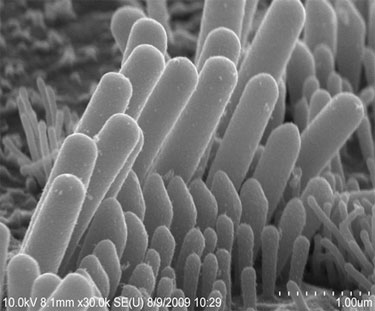
Stereocilia perch atop sensory pilus cells in the inner ear.
Source: Yoshiyuki Kawashima
Nigh NIHL is acquired past the harm and eventual death of these hair cells. Unlike bird and amphibian pilus cells, human hair cells don't abound back. They are gone for good.
What are the effects and signs of NIHL?
When you are exposed to loud noise over a long menstruum of time, y'all may slowly offset to lose your hearing. Because the damage from racket exposure is usually gradual, yous might not observe it, or you lot might ignore the signs of hearing loss until they become more pronounced. Over fourth dimension, sounds may become distorted or muffled, and you might find it hard to understand other people when they talk or have to turn upward the volume on the boob tube. The impairment from NIHL, combined with crumbling, can pb to hearing loss severe enough that yous need hearing aids to magnify the sounds around you to help you hear, communicate, and participate more fully in daily activities.
NIHL can too be acquired past extremely loud bursts of sound, such as gunshots or explosions, which can rupture the eardrum or damage the bones in the middle ear. This kind of NIHL can be immediate and permanent.
Loud noise exposure can also crusade tinnitus—a ringing, buzzing, or roaring in the ears or head. Tinnitus may subside over fourth dimension, merely tin can sometimes continue constantly or occasionally throughout a person'due south life. Hearing loss and tinnitus tin occur in one or both ears.
Sometimes exposure to impulse or continuous loud dissonance causes a temporary hearing loss that disappears 16 to 48 hours later. Recent inquiry suggests, however, that although the loss of hearing seems to disappear, there may be residual long-term damage to your hearing.
Can NIHL exist prevented?
NIHL is the just type of hearing loss that is completely preventable. If yous understand the hazards of noise and how to practise good hearing health, you tin can protect your hearing for life. Here's how:
- Know which noises tin cause harm.
- Article of clothing earplugs or other protective devices when involved in a loud activity (activeness-specific earplugs and earmuffs are available at hardware and sporting appurtenances stores).
- If you can't reduce the noise or protect yourself from information technology, motility away from information technology.
- Be warning to hazardous noises in the surroundings.
- Protect the ears of children who are also young to protect their own.
- Make family, friends, and colleagues aware of the hazards of noise.
- Have your hearing tested if you lot think you might have hearing loss.
What research is existence washed on NIHL?
The National Institute on Deafness and Other Communication Disorders (NIDCD) supports inquiry on the causes, diagnosis, treatment, and prevention of hearing loss. NIDCD-supported researchers have helped to identify some of the many genes of import for pilus-cell evolution and office and are using this knowledge to explore new treatments for hearing loss.
Researchers are besides looking at the protective properties of supporting cells in the inner ear, which announced to be capable of lessening the damage to sensory pilus cells upon exposure to dissonance.
The NIDCD sponsors It's a Noisy Planet. Protect Their Hearing®, a national public education campaign to increase sensation among parents of preteens about the causes and prevention of NIHL. Armed with this information, parents, teachers, school nurses, and other adults can encourage children to adopt healthy hearing habits.
Where can I find boosted information about NIHL?
The NIDCD maintains a directory of organizations that provide information on the normal and matted processes of hearing, residue, taste, olfactory property, voice, oral communication, and language.
Use the following keywords to assistance you discover organizations that can answer questions and provide information on NIHL:
- Noise-induced hearing loss
- Hard of hearing
- Tinnitus
NIDCD Data Clearinghouse
1 Advice Artery
Bethesda, MD 20892-3456
Toll-free voice: (800) 241-1044
Toll-gratis TTY: (800) 241-1055
Email: nidcdinfo@nidcd.nih.gov
NIH Publication No. fourteen-4233
Updated March 2014
Source: https://www.nidcd.nih.gov/health/noise-induced-hearing-loss
0 Response to "what happens to your hearing at 90 decibels of volume"
Enviar um comentário